
1. No more 'no‑fault' evictions (Section 21)
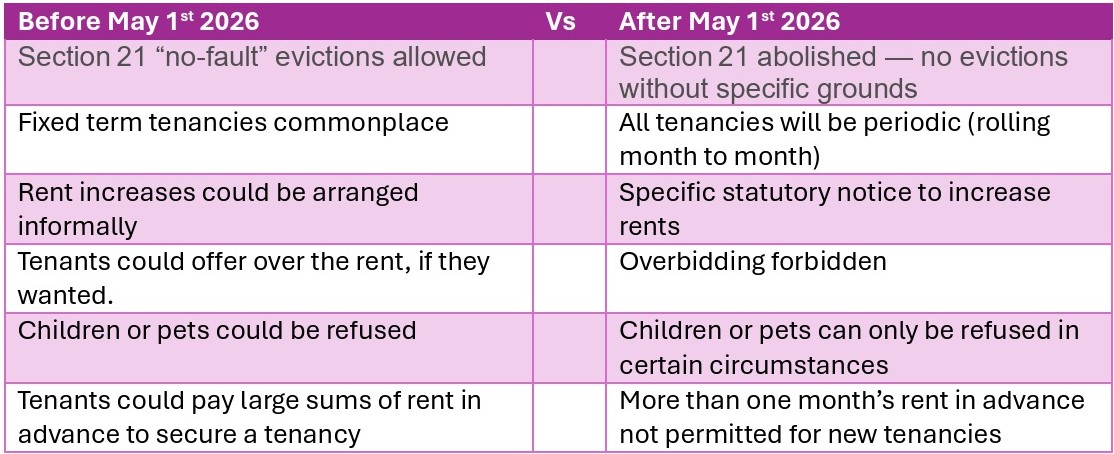
From 1st May 2026, the legal route that allowed landlords to repossess a property without giving any reason — a Section 21 notice — will be abolished under the Renters’ Rights Act. That means landlords cannot legally ask tenants to leave just because they want their property back or don’t want to renew the tenancy.
Instead, landlords must use a Section 8 possession notice and rely on one or more legally defined grounds for possession — i.e., specific reasons recognised by statute.
2. Change to tenancy types
All existing Assured Shorthold Tenancies (ASTs) will become Assured Periodic Tenancies (APTs) on 1st May 2026, and fixed‑term ASTs can no longer be granted once the Act takes effect. This means all tenancies will roll on month‑to‑month, giving tenants greater flexibility and landlords a new framework for notice periods.
3. Lawful grounds for eviction under the RRA
Once Section 21 is abolished, landlords must have a valid statutory reason — a ground for possession — and issue a Section 8 notice specifying that ground. The courts will not grant possession unless the landlord proves a ground applies.
Main grounds landlords can use:
These are examples of the types of grounds (outlined in the revised Schedule 2 of the Housing Act 1988, as amended by the RRA) landlords can rely on:
Grounds based on landlord’s own situation
These are mandatory grounds — if conditions are met, the court must order possession:
- Landlord (or close family) intends to live in the property as their main home.
- – You generally must demonstrate genuine intention and give the required notice period (4 months).
- Landlord intends to sell the property (new ground).
- – Must be genuine; the court will require evidence. Notice period 4 months.
- Grounds related to tenant behaviour
These can be mandatory or discretionary depending on circumstances:
- Rent arrears — where significant rent is owed, the court may grant possession.
- – Higher arrears and clear evidence make a stronger case. Noitce period 4 weeks.
- Breach of tenancy agreement — e.g., subletting without permission, unauthorised pets, etc.
- – This is usually discretionary and the judge weighs reasonableness. Notice period varies from 2 weeks to 4 months, depending on the breach.
- Anti‑social behaviour or criminal conduct at or near the property.
- – This includes nuisance; serious misconduct may support an immediate claim, less serious offences might require 2 weeks notice.
Other statutory grounds
- Student accommodation turnover situations — a specific ground to regain possession for seasonal letting patterns.
Additionally, the RRA introduces and amends multiple grounds — potentially expanding to dozens of statutory reasons — all of which come with defined notice periods and evidential requirements. Notice periods vary from 2 weeks to 4 months, depending on the scenario.
4. Important practical points
Notice periods
Each ground has a different notice period that must be complied with before court proceedings can start, and these are generally longer than under the old regime.
The court’s role
Serving a notice alone does not end a tenancy. If the tenant does not vacate by the required date, the landlord must apply to the court and prove the ground. The court then decides whether possession is reasonable and appropriate.
Documentation and evidence
The landlord must:
- serve the correct Section 8 notice form,
- clearly indicate one or more valid grounds,
- and have documented evidence supporting the reason (e.g., rent statements, correspondence about behaviour, sales evidence).
Summary for landlords
If you’re a landlord preparing for these changes, it’s a good idea to review your current tenancies and management practices, ensure compliance now, and potentially get specialist legal advice on how to compile strong evidence packages for valid grounds before you serve a Section 8 notice.